Marketing Automation vs. AI Agents: What's Actually Different
Automation follows rules. Agents pursue goals. The gap between them is wider than most marketers realize.
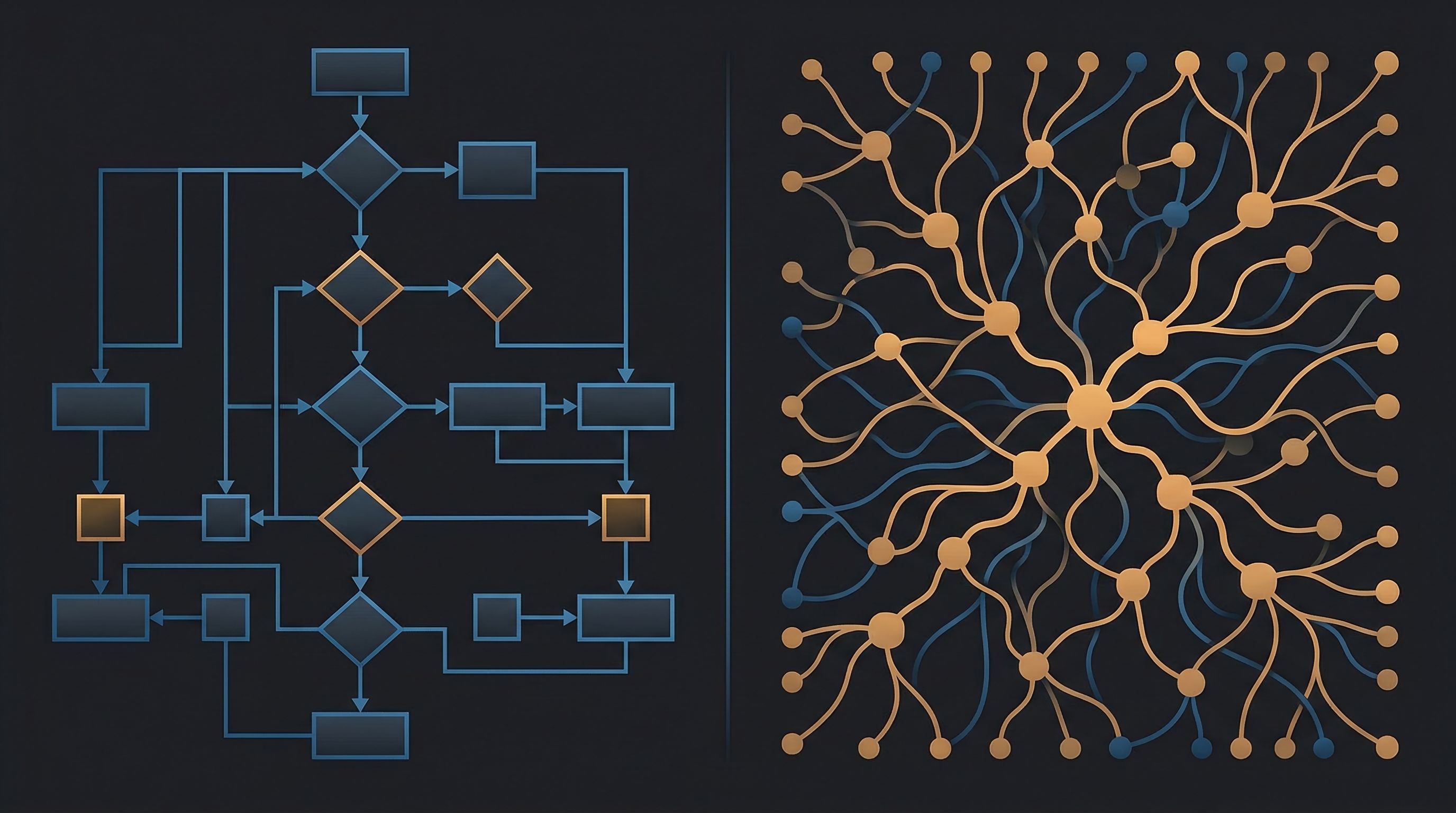
Marketing automation reduces repetitive labor without reducing cognitive labor. Someone still has to think. AI agents change that equation entirely.
Marketing professionals have spent fifteen years layering tool on top of tool in search of the same elusive goal: a marketing operation that runs itself. First came email drip campaigns. Then CRM workflows. Then multi-channel automation platforms promising to connect everything. And yet, the typical marketing team still spends most of its time on coordination, context-switching, and manual adjustment — the glue work that automation was supposed to eliminate.
Now a new category has arrived with a more ambitious promise: AI agents. Vendors claim they are fundamentally different from traditional marketing automation. But most marketers, reasonably skeptical after years of overpromised software, want to understand the actual difference before betting headcount or budget on it.
The difference is real. It is also specific enough to measure.
What marketing automation actually does
Traditional marketing automation operates on rules. A contact fills out a form → add them to a nurture sequence. A user hasn't opened an email in 90 days → mark them inactive. A deal reaches stage three in the CRM → trigger a sales alert.
This logic is enormously powerful within its limits. Platforms like HubSpot, Marketo, and Klaviyo have helped companies scale campaigns that would have been impossible to run manually. At their best, they turn reliable, repeatable processes into reliable, repeatable software.
But the operative word is reliable — as in fixed, predictable, known in advance. Marketing automation can only execute what a human has already thought through and encoded as a rule. When the world changes — a campaign underperforms, a competitor launches, a new channel emerges — the automation doesn't adapt. It keeps running the old playbook until a human notices, diagnoses the problem, rewrites the workflow, and reruns the campaign.
The result is that marketing automation reduces repetitive labor without reducing cognitive labor. Someone still has to think.
What AI agents actually do
An AI agent is a system that can observe its environment, reason about what it sees, decide what to do, act on that decision, and then observe the results and update accordingly.
In a marketing context, that cycle looks like this: an agent monitors campaign performance data, notices that a particular blog post is generating significantly more organic traffic than usual, identifies which downstream pages it should link to in order to capitalize on that traffic, updates the internal links without being asked, and logs what it did and why.
No rule triggered that sequence. No human approved each step. The agent perceived a situation, formed a hypothesis, took an action, and closed the loop — all within a coherent goal: grow organic traffic.
This is qualitatively different from automation. Automation follows instructions. An agent pursues goals.
The practical implication is significant: AI agents can handle situations that were never anticipated at setup time. They can coordinate across tools that weren't designed to work together. And over time, they accumulate the kind of contextual understanding that previously lived only in the heads of experienced team members.
The five dimensions that separate them
| Dimension | Marketing Automation | AI Agents |
|---|---|---|
| Decision logic | Rules-based (if/then) | Reasoning-based (observe, plan, act) |
| Novel situations | Fails silently or stalls | Adapts based on context |
| Learning | Static until reprogrammed | Improves from outcomes |
| Cross-tool coordination | Fragile integrations | Native, goal-directed |
| Human oversight needed | High (constant rule maintenance) | Strategic (set goals, review results) |
Traditional automation requires humans to be prescient — to anticipate every scenario and write a rule for it. AI agents require humans to be directive — to set clear goals and constraints, then let the system figure out how to achieve them.
This is not a minor upgrade. It represents a fundamentally different theory of how software should participate in marketing work.
Where AI agents beat automation
Judgment calls at the margin
Marketing is full of decisions that don't fit cleanly into a rule. Should this email subject line be rewritten? Is the conversion rate on this landing page low enough to warrant a test, or is the sample size just too small to read? When a content piece starts ranking for an unexpected keyword, should we lean into that angle or stay the course?
These are judgment calls — the kind of contextual reasoning that traditional automation can't touch. AI agents, because they reason rather than follow rules, can handle them. Not perfectly. But often well enough to act where a human would have hesitated, and to flag situations where human review genuinely matters.
Cross-channel coordination
One of the chronic frustrations of modern marketing stacks is that tools don't talk to each other intelligently. Your SEO data lives in Semrush. Your paid data lives in Google Ads. Your organic social data lives across three platforms. Your CRM has conversion data that none of these systems see.
A human analyst stitches this together by hand. Traditional automation can trigger actions based on data from a single source. AI agents, connected to multiple data streams, can reason across all of them simultaneously — adjusting paid spend in response to a spike in organic, shifting content priorities based on what's actually converting in the CRM, or pulling back on a channel that's generating noise but not revenue.
This kind of cross-channel intelligence has historically required a senior strategist. Agents make it continuous and automatic.
Anomaly response at speed
Markets move faster than weekly reporting cycles. When a competitor announces a price cut, when a new keyword cluster suddenly starts trending, when a campaign goes viral on an unexpected platform — timing matters enormously. Traditional automation doesn't monitor for what it wasn't told to watch. AI agents can surface and respond to anomalies in near real time, executing the first-response playbook before a human even opens their laptop.
Where traditional automation still belongs
This is not an argument that automation is obsolete. For high-volume, stable, well-understood processes — transactional email, basic lead nurturing, form routing, CRM data hygiene — rule-based automation is more reliable, more auditable, and cheaper to run than an agent-based system. You don't need an AI agent to send a welcome email when someone signs up.
The failure mode to avoid is using automation logic to handle situations that require judgment, and then wondering why your marketing keeps needing human rescue.
What an autonomous marketing team actually looks like
The practical reality of what a fully agentified marketing operation does is still unfamiliar to most teams. Here is a concrete example.
An autonomous marketing agent connected to Google Search Console, Ahrefs, and a CMS like WordPress monitors keyword rankings weekly. When it detects that a previously high-performing post has slipped from page one to page two, it pulls the current content, benchmarks it against the top three ranking pages for that keyword, identifies the gaps — missing subheadings, thinner word count, weaker internal link structure — and submits a revised draft for human review. It doesn't wait to be assigned the task. It doesn't need a workflow trigger. It acts because it understands the goal: organic search visibility.
Multiply that across SEO, paid search, email, social, and analytics — with agents that coordinate with each other and share context — and you begin to see what a true autonomous marketing team looks like. Not a set of automated workflows, but a group of goal-directed systems that collectively own the marketing function.
Platforms like Ivon are built on exactly this architecture: a team of AI marketing agents that integrate natively with the tools your business already runs — Google Analytics, HubSpot, Salesforce, Ahrefs, Semrush, Google Ads, LinkedIn, Shopify, Slack — and coordinate across them to execute your growth strategy without requiring a human to manage each handoff.
The question worth asking
The right question isn't "should we use AI agents or marketing automation?" Most mature marketing teams will use both, for different purposes.
The more useful question is: which parts of your marketing are constrained by the cognitive overhead of maintaining rules, routing tasks, and stitching together data — and what would it free up if those parts ran themselves?
For most teams, the honest answer is: most of it.
The teams that recognize this early — and build their operations accordingly — are the ones that will compound their advantage over the next several years. The technology is no longer experimental. The only question is whether you use it or watch someone else use it against you.
Ready to see what an autonomous marketing team looks like in practice? Explore Ivon →